Lead generation and demand generation solve different problems in B2B marketing.
Neither strategy is inherently better. The right choice depends on the challenge a business is trying to solve.
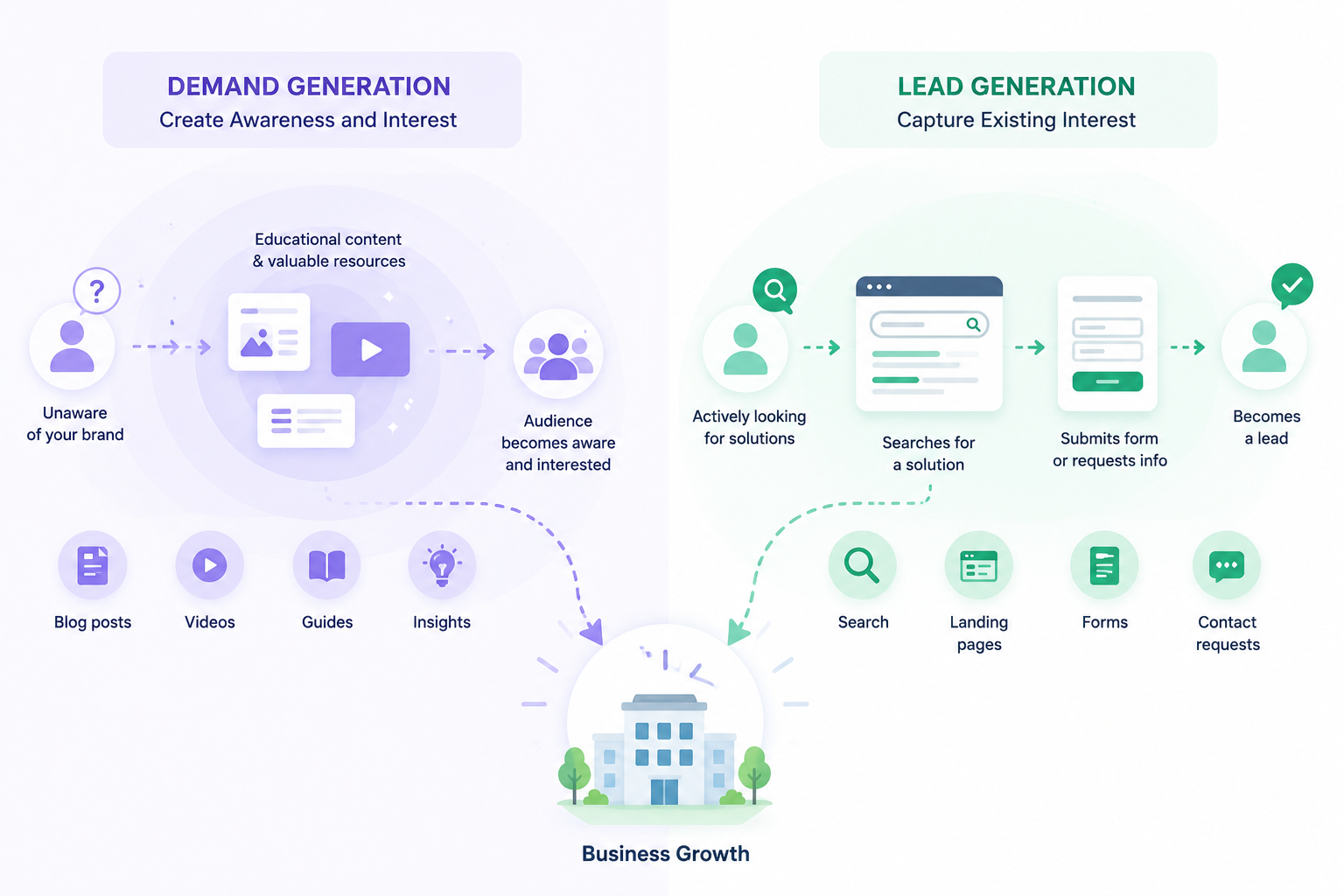
Demand generation helps more potential buyers discover a company and its solution. Lead generation turns that interest into inquiries, demo requests, and other sales opportunities.
Problems arise when one strategy is expected to do the other's job. A company may generate leads before building enough interest, or build interest without giving potential customers a clear way to get in touch.
Understanding the difference can help you make better marketing decisions.

Lead Gen vs Demand Gen
Lead generation and demand generation are both crucial for strong branding, however, they do different things.
Demand generation introduces a company/business to people who may not know it exists. This happens through content that answers questions or explains industry problems:
- educational articles,
- research reports,
- webinars,
- videos,
- podcasts,
- etc.
Lead generation comes after that.
It gives interested people a way to contact the company or request more information.
Common demand generation tactics include:
- Educational content
- Research reports
- Industry webinars
- Podcasts
- Social media content
- Thought leadership content
For example, a company publishes a report about rising cybersecurity threats. Someone finds the report while researching online and learns about the company behind it. That is demand generation.
Later, that same person fills out a form to request a demo. That is lead generation.
The simplest difference between lead gen and demand gen is:
- One creates interest.
- The other captures interest.
Demand Generation
Lead Generation
Introduces people to a company
Collects contact information from interested people
Uses articles, reports, webinars, videos, and events
Uses forms, demos, free trials, and consultations
Happens before someone reaches out to the company
Happens when someone decides to reach out
Measured through visibility, traffic, and engagement
Measured through inquiries, demo requests, and signups
Demand generation is a long-term strategy
B2B demand generation invests in future customers rather than immediate inquiries.
Instead of asking visitors to book a demo or submit their contact information, companies publish useful content that answers questions, explains industry challenges, and shares expertise. This content often supports SEO efforts by attracting potential customers during the research stage, long before they are ready to speak with sales.
The following examples show how to create demand before buyers begin actively looking for a solution.
- Educational content
- Research reports
- Industry webinars
- Podcasts
- Social media content
- Thought leadership content
As a result, demand generation often takes longer to show results. The goal is to stay visible and useful until a potential customer is ready to buy.
Lead generation aims to turn interest into inquiries
Lead generation asks potential customers to take a specific action.
That action may be requesting a demo, booking a consultation, signing up for a trial, or downloading a resource in exchange for contact information.
Because the goal is immediate action, lead generation campaigns often rely on offers, forms, landing pages, and other conversion-focused assets. Results are also easier to measure because businesses can track how many inquiries, signups, or demo requests each campaign produces.
This is why lead generation remains a common priority for companies that need provable results within a shorter timeframe.
How to decide between demand generation and lead generation
The right strategy depends on where potential customers drop off.
Demand generation works best when awareness is the problem
Demand generation strategy deserves more attention when not enough potential customers know about the business.
Let's say you offer cybersecurity services for small businesses. Your website receives little traffic, prospects rarely mention your brand during sales calls, and most conversations start with explaining why the security issue matters in the first place.
In this situation, lead generation campaigns often struggle because there are too few interested buyers to convert. That’s why building awareness and educating the market usually delivers better results than pushing for more demo requests or contact form submissions.
Lead generation works best when conversions are the problem
Say a software company attracts steady website traffic. Visitors reach product and pricing pages, yet demo requests and contact form submissions remain low.
More awareness is unlikely to solve the problem. People already show interest in the product, but few take the next step. This is where lead generation becomes the priority of your digital strategy.
The goal is to turn existing interest into inquiries and qualified leads.
B2B demand generation and lead generation use different metrics
The two strategies aim for different outcomes, so they should not be measured the same way.
Since demand generation tries to increase visibility and interest, the metric to pay attention to are:
- Brand searches
- Website traffic
- Returning visitors
- Content engagement
- Social shares and mentions
As lead generation is used to turn interest into inquiries, the list of metrics looks like this:
- Contact form submissions
- Demo requests
- Trial signups
- Marketing-qualified leads (MQLs)
- Sales-qualified leads (SQLs)
- Cost per lead
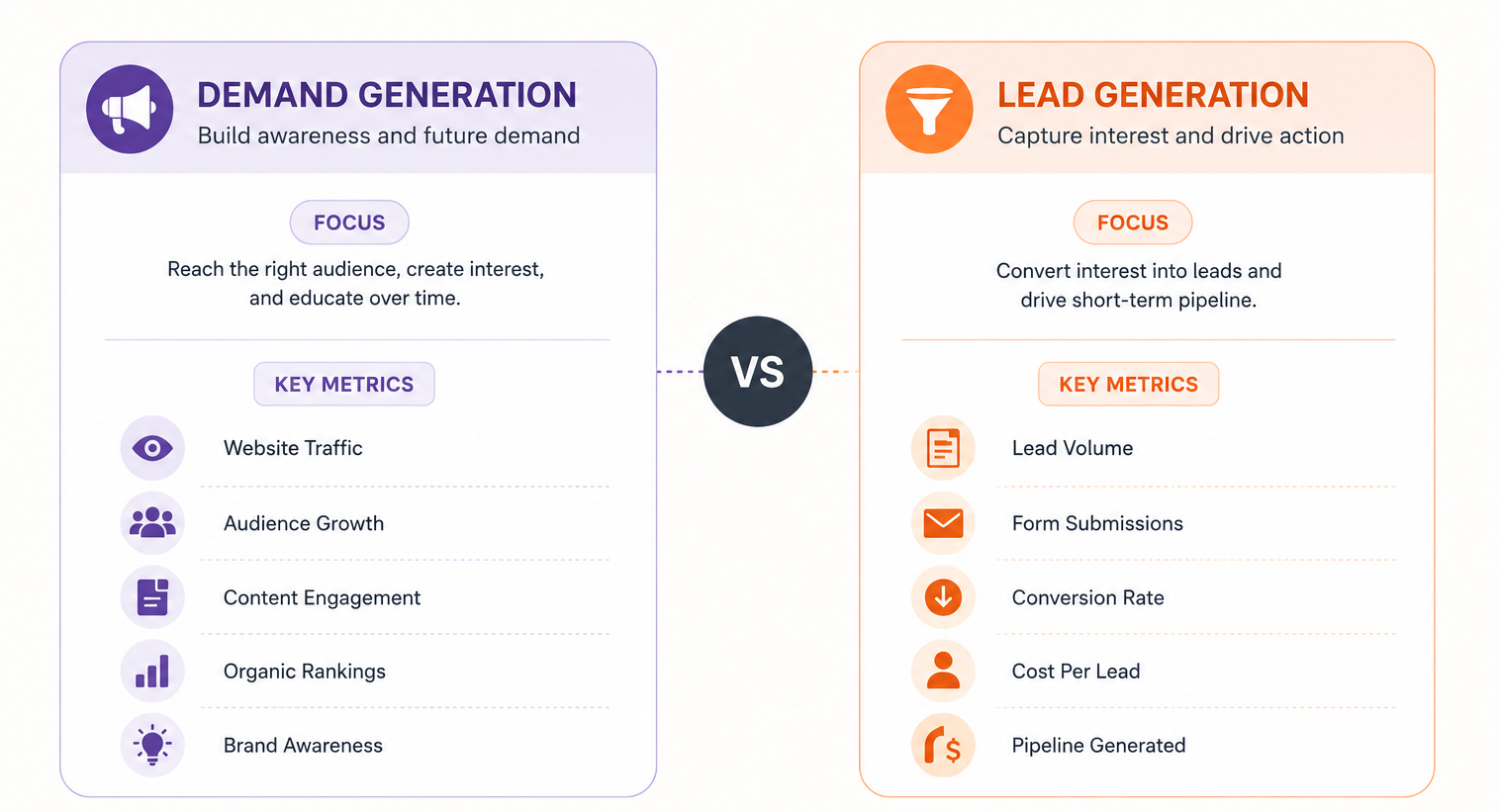
Measuring both strategies the same way is like judging a billboard and a contact form by the same standard.
One helps more people discover the business. The other helps interested people reach out.
Why funding the wrong strategy wastes budget
Lead generation and demand generation solve different problems, which means success looks different for each one.
A company may invest heavily in lead generation and see more contact form submissions, demo requests, and other lead metrics. Yet sales remain flat because too few potential buyers know the brand or understand the problem it solves. More leads do not automatically translate into more customers.
Demand generation can create the opposite outcome.
Website traffic grows, more people discover the content, and brand searches increase. Yet inquiries remain limited because interested visitors have no clear path to request a demo, book a consultation, or contact the company. Visibility improves, but revenue opportunities do not grow at the same pace.
Neither strategy is ineffective itself.
Problems arise when a company tries to generate more leads before building enough interest, or builds interest without giving potential customers a way to get in touch. In both cases, part of the marketing budget goes toward the wrong objective while the real obstacle remains unresolved.
Need help figuring the best strategy out?
Choosing between demand generation and lead generation starts with understanding what is holding growth back.
If you're unsure where your marketing budget should go, Jungle Creatives can help you identify the problem, evaluate your current performance, and build a strategy around your business goals.