I was sitting in a village last weekend when a guy asked me: "Are you scared AI is going to take your job?"
I smiled. Because I've heard this question a lot. And every time, I think we're asking the wrong one.
I told him: this has happened before. Many times.
When the printing press arrived in the 15th century, scribes whose entire livelihood was copying manuscripts by hand lost their work overnight. When the industrial revolution mechanized textile production, hand weavers across England and Europe were displaced in a generation. When Ford introduced the assembly line, craftsmen who built carriages and wagons had to find new purposes. When supermarkets arrived, thousands of small neighborhood shops closed their doors. When ATMs were introduced in the 1970s, everyone predicted the end of bank tellers. There are more bank tellers today than before ATMs existed.
Every single time, we adapted. Not without pain. Not without loss. But we adapted.
The pattern is always the same. A new technology arrives. It automates the repetitive, the mechanical, the predictable. And it creates space, whether we choose to use it or not, for something more human.
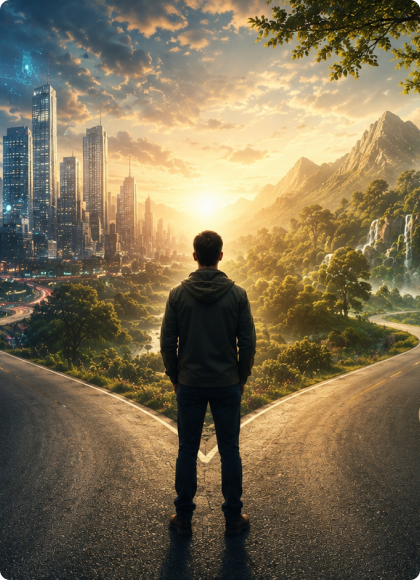
The question was never "will AI take our jobs." The real question is what we choose to do with the time it gives back.
And this is where I think we've lost the plot entirely.
The system we live in has made us terrified of AI replacing our work. But somehow, it has not made us terrified of not knowing how to grow our own food. It has not made us terrified of the fact that most people today couldn't name a single wild plant in the area they grew up in. It has not made us terrified of the growing distance between human beings and the natural world that has sustained us for all of recorded history.
I use AI every day. Not to do more work. To finish work faster so I can do less of it. So I can spend a morning in a garden instead of in front of a screen. So I can be present in a conversation instead of preparing for the next meeting.
That's what automation is supposed to do. It always was.
The weavers who lost their jobs to machines didn't lose their ability to cook, to farm, to build, to care for each other. What they lost was a system that valued those things. We've been losing that same thing, slowly, ever since.
Creativity cannot be automated. Healing cannot be automated. Growing something from a seed, raising an animal, sitting with someone who is grieving, teaching a child to read, making something with your hands because it matters to you, not because someone is paying you. These things don't have an API.
So no. I'm not afraid of AI.
I'm afraid of a world where we outsource our work to machines and then spend the time we freed up staring at more screens. Where we become more productive and less alive. Where we solve the labor problem and deepen the disconnection problem.
I'm afraid of a generation that knows how to prompt an AI but doesn't know how to plant a vegetable or read a weather pattern or spend a day without WiFi.
The guy in the village who asked me that question grows his own food, fixes his own roof, and has never once worried about whether his skills are still relevant. He is, by any real measure, more prepared for the future than most people I know in tech.
AI is not the threat. Forgetting what it means to be human is.
%20(1).jpg)