Digital marketing is likely to fail before digital marketing can successfully advertise one of its campaigns. The most common breakdown is with the marketing plan, not with the advertising. By the time the marketing team initiates the advertising campaign, the plan for the marketing campaign has already been set.
When marketing teams do their advertising campaigns, there are bound to be mistakes. In most cases, the marketing teams do not do the advertising campaigns, do not clearly define their goals, do not follow through with their plans, do not advertise within reasonable expectations, and do not stick to the same media advertising platform. These are not tactical advertising mistakes; these are structural ones. And structure is what defines the quality of the marketing campaign plan.
The purpose of this article is to analyze the digital marketing structure and to determine which structures need to be kept and which structures can be replaced with more effective structures.
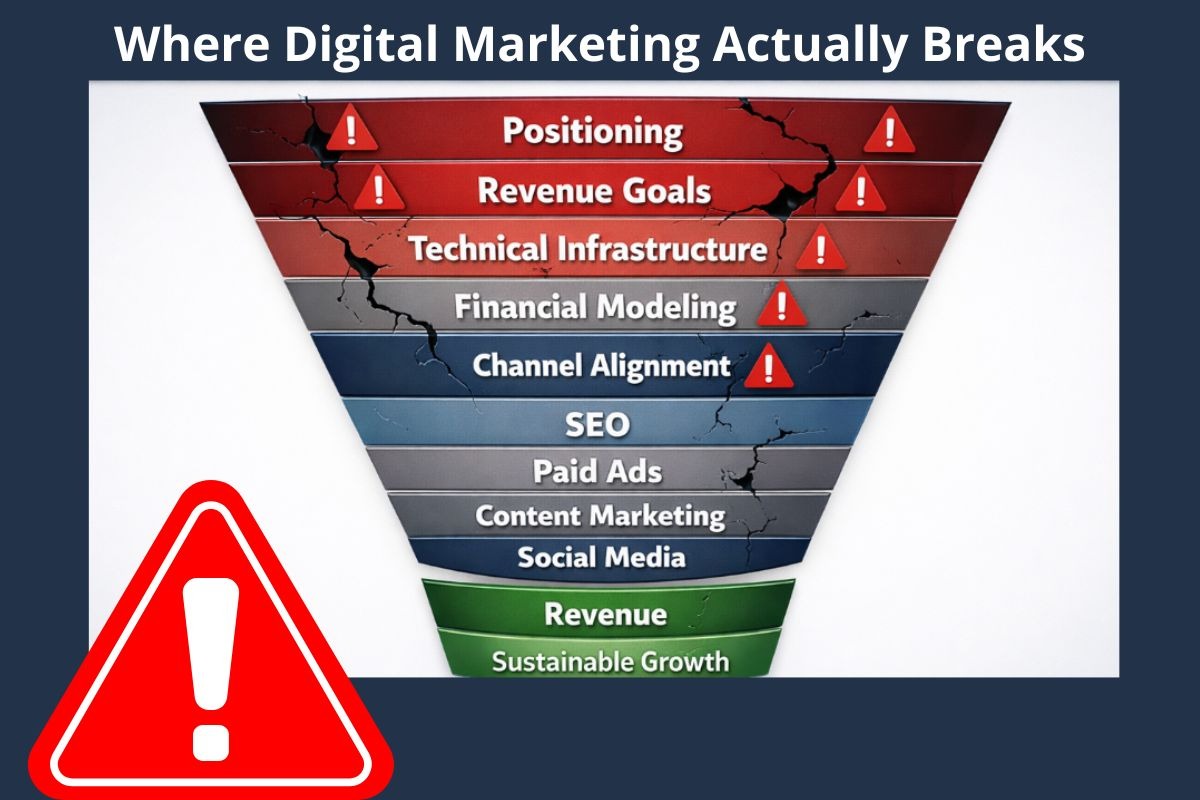
The Real Reasons Digital Marketing Fails Before Launch
The structural weaknesses of these underperforming campaigns are almost exactly the same every time. Different structures can be applied to different marketing industries using the same strategies.
Advertising Positioning
As advertising strategies go, advertising positioning is one of the most critical components. And without advertising positioning, the advertising strategies for the campaigns will be disorganized.
Many businesses start marketing without knowing who their audience is and what problem their solution solves. They also don’t consider why their audience would choose their business over competitors. This lack of clarity leads to generic messaging, wide targeting, and low conversion rates.
If all a business claims is, “We provide excellent marketing services,” they are no different than countless others. However, a business that offers services such as SEO for local health care providers or conversion-centered web design for B2B companies is relevant to their target audience.
One of the most common digital marketing mistakes is a lack of good positioning. When this deficiency exists, audience traffic can increase while the interaction remains the same. Positioning affects all components of the marketing plan, such as website content, advertising, and pricing strategies. If the digital marketing strategy is built on weak positioning, it will translate to poor performance.
Goals That Don't Connect to Revenue
Digital marketing is also failing due to a lack of clarity on the target goals.
Most businesses target metrics such as website traffic, number of followers, or number of impressions. These are good indicators, but they don’t translate to positive business results. Business growth relies on pinpointing revenue goals, customer acquisition cost, and lead quality.
Marketing becomes reactive when goals are unclear. Teams celebrate click-through rates but fail to measure their actual conversions. They increase their ad spend without understanding the importance of customer lifetime value.
An e-commerce store is pleased to double its website traffic; however, if the conversion rate and average order value have not changed, the store is not growing but simply becoming busier.
When goals are clear, teams can create a plan. They define what success looks like and make decisions easier. Numbers on the surface may look good, but without goals, the business will advance digital marketing and fail.
Weak Technical Infrastructure
No strategy can outperform a broken system.
Businesses often invest money in advertisements or SEO before fixing the more mundane and basic technical issues, such as page load times, mobile interface issues, broken tracking, and customer relationship management (CRM) systems that are not integrated with lead form submissions. Bad data leads to bad decisions when analytics are broken. Without conversion tracking, there is simply no means to measure what is being scaled.
Optimization is impossible when paid advertising is generating leads, but there is no clear relationship from campaign to sale. Financially irrational decisions are made when there is no clear measure of value.
Weak infrastructure leads to slow, not immediately visible failure. What weak infrastructure does is create slow leaks, and over time, those leaks drain performance. The performance drain leads to digital marketing failure, where nobody can explain why the failure happened, and marketing people fail to generate performance.
Unrealistic Expectations About Time and Scale
Impatience is a structural problem too.
Content marketing is not an overnight process. Neither are paid ads, which require multiple rounds of testing in order for them to optimize. SEO requires consistent effort before a website's ranking improves. It is a gradual process, and not an overnight process.
However, businesses do not see fast results and expect them to be present. They then pivot and do an agency switch in order to get fast results. There is an expectation of immediate results, which is where the problem lies. The data had not matured, nor had the strategies been given time to stabilize. It should not be the expectation that certain channels "just don’t work" because of the time frame that is given. Ultimately, the problem from day one was the timeline.
Digging into the reasons behind the failures of digital marketing means recognizing that the marketing cycle and the business growth cycle are not aligned. In the beginning, explosive growth is not likely to happen, and instead, growth is more likely to be gradual, needing the business to do iterative activities, ensure the collection of the right data, and make the right adjustments based on the data. Businesses that are able to make firm commitments to testing and adjusting their marketing activities are likely to see compounding returns, while those that do not are even less likely to see growth.
Marketing Is More Than Just Execution
Marketing is more than just the execution of activities on different platforms. When each element of a marketing plan is executed as a stand-alone element, then the marketing plan as a whole is going to be more likely to fail.
Poor execution is often observed as disconnected and unaligned activities across marketing channels. Examples of this include ads promoting a deal that the site offers but is not advertised anywhere on the site, a blog that attempts to rank for a targeted keyword but is not aligned with the business’s core competencies, and social media posts that directly or indirectly go against the company’s mission and vision. Each marketing channel's tools may appear to be functioning optimally, but the result is that the tools are not mutually reinforcing.
When there are multiple channels, with unaligned and disconnected content, the marketing ecosystem is going to be more likely to be a failure. Investing in marketing tech and industrial tools is not going to be effective in their places, and instead, the focus needs to be on the alignment and cohesion of company objectives, value, mission, and vision, the positioning family, messaging, funnel design, and metrics to achieve the desired outcome.
Financial modeling for digital marketing campaigns is one of the more ignored causes of a marketing plan’s failure. This will be especially true for models that are constructed after the marketing activities have already begun.
Effective marketers have a clear understanding of the numbers behind the growth. They know the estimated conversion rates, the customer lifetime value, and the acceptable cost per acquisition. Without these numbers, scaling becomes purely emotional.
Consider a service company that earns $3,000 per client and has a 25% win ratio on qualified leads. If there has been no calculation on what the acceptable cost per lead is, then the ad spend is going to be set too high or too low, and growth will be unsustainable.
Most beginner guides omit this level of detail. However, this is exactly what allows some campaigns to scale sustainably while others remain chaotic.
When there is no financial alignment, digital marketing will fail. It’s not because the channels are broken. It’s because the economics of the situation have not been proven to work.

Strategic Problems Show Themselves In Tactical Mistakes
Tactical mistakes can be seen, but strategic mistakes are not visible.
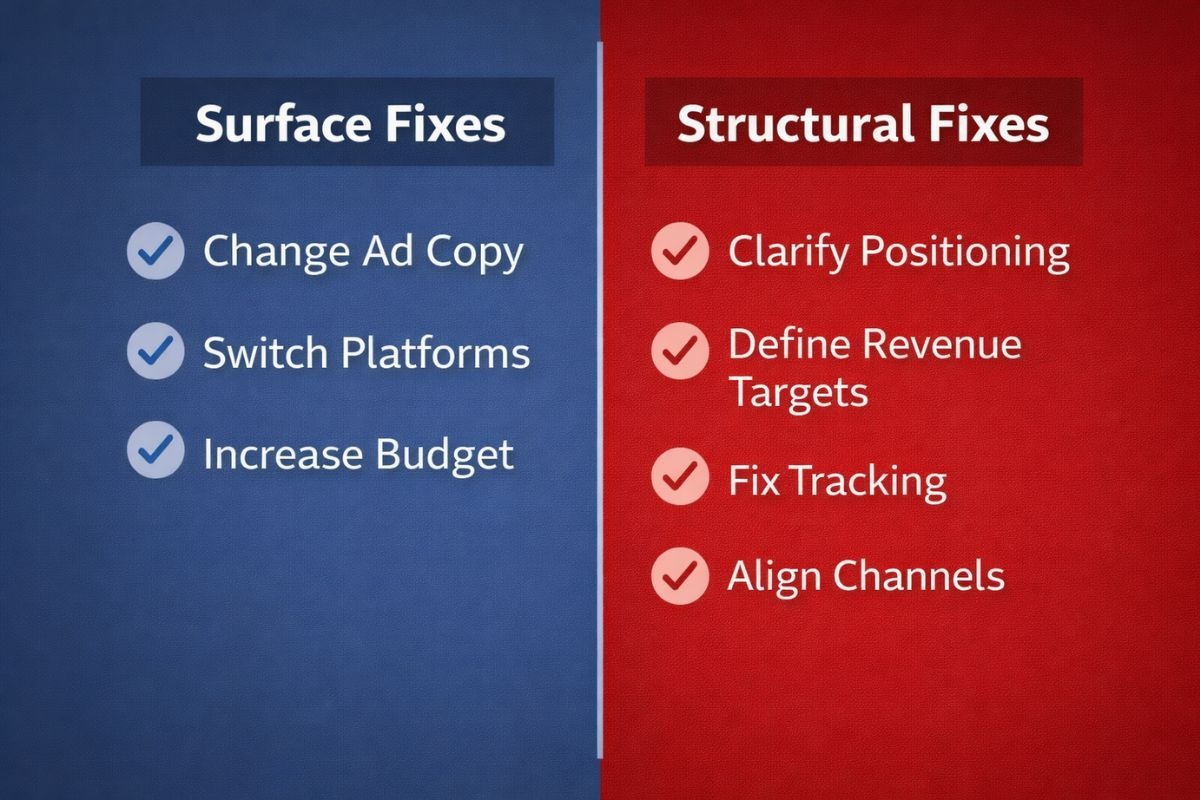
An insufficient ad can be rewritten, and a bad landing page can be redesigned. However, major rework is often what is needed to fix issues related to a lack of clear positioning, broken systems for tracking, and alignment amongst goals.
It is often the case that foundational issues can remain undiagnosed for long periods of time, and traffic will continue to flow, reports will be active, and revenue will continue to stagnate. Eventually, the failure leads to frustration, which in turn leads to the company looking at competitors, the algorithm, or the market to explain the stagnation. In many instances, the problem goes back to the initial choices made in these foundational issues.
Structural Issues Hide Behind Tactical Noise
Digital marketing is doomed to fail when the execution outpaces the strategy.
Before hasty increases to advertising budgets or a greater volume of content, the fundamentals must be established. Positioning should be meticulous. Objectives must be revenue-linked. Technical systems must be accurate. Expectations must align with timelines. Integrated channel strategy must supersede siloed channel tactics.
Once the above components are established, campaigns will have the latitude to mature. Data will become meaningful, and optimization will be proactive rather than merely tactical, resulting in greater predictability of marketing outcomes.
The discipline in structure may feel like it is moving in slow motion. However, it will prevent expensive resets in the future. Strong marketing is built, not rushed, and with a solid foundation, scaling becomes significantly more efficient.

%20(1).jpg)