Every brand wants higher conversion rates, but many overlook the silent killer to watch for in their marketing: inconsistency.
When your ad says one thing, your landing page says another, and your social media tells a completely different story, you're actively destroying your customers’ trust.
What inconsistent branding does is create cognitive friction at every touchpoint, forcing potential buyers to question your legitimacy instead of clicking "buy." In this article, we'll explore how misaligned branding damages conversion rates and what you can do to fix it.
The Psychology Behind Conversion and Trust
Conversions are decisions based on trust.
Before making a purchase or completing a lead form, visitors will internally question:
- Is this company legitimate?
- Do they understand my problem?
- Can I trust this?
- Is everything aligned?
With consistency, trust is built without explanation. When all elements are visually, aurally, and sensorially cohesive, the mind is at ease. Repeated exposure increases trust and increases the likelihood of conversion.
On the other hand, branding that is inconsistent will create trust and conversion barriers.
The Effects of Inconsistent Branding on Buyer Behavior
The effects of inconsistent branding extend far beyond confusion. It damages buyer perception on a psychological level.
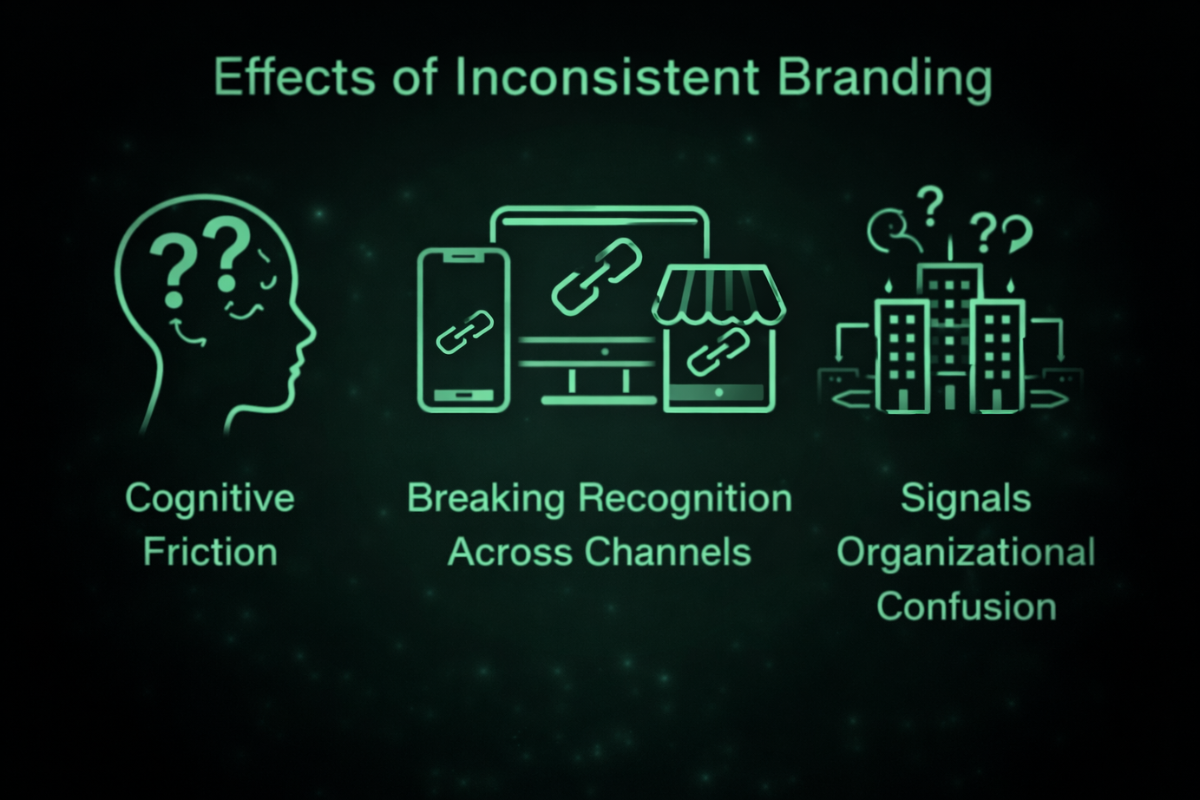
1. Cognitive Friction
When an ad landing page mismatch occurs, the brain begins to work to resolve the difference. In digital advertising, micro-friction is the enemy of success.
Consider this example.
- An ad promises “affordable premium solutions.”
- The landing page is focused on “enterprise-grade innovation.”
- A competing homepage says “simple tools for beginners.”
Which is it? Premium? Enterprise? Beginner-friendly? Affordable?
That ambiguity you see right there creates doubt.
2. Breaking Recognition Across Channels
Brand recognition is cumulative. Every impression should build on the previous one.
If:
- The Google search result has a formal tone
- The website has playful language
- Social media has a sarcastic and edgy tone
- Email marketing is corporate
This brand is never solid in the customer's mind. Instead of building momentum, each touchpoint resets the relationship.
Recognition builds familiarity. Familiarity builds trust. Trust builds conversions.
3. Signals Organizational Confusion
Customers view inconsistency as internal organizational confusion.
The different colors, poor messaging, and channel-specific offers show a lack of coordination. While operations could be organized perfectly, perceptions are more important to customers, and they see poor coordination.
A disjointed brand increases customer perception of danger, and danger decreases conversion.
Inconsistent Messaging: The Silent Killer of Your Revenue
Messaging failure and inconsistency are frequently the largest contributors of brand’s identity issues.
Value propositions misalignment
A brand can position itself as:
- Budget-friendly in advertising
- Premium on the website
- Innovative in the blog
- Traditional and reliable in email
This is a huge mess, and surely not something you can call strategic. But, when a brand’s messaging is coherent and consistent across all channels, it makes customers’ decision-making as easy as it comes.
Search Intent vs. Brand Promise
The search intent of users will conflict with the brand promise.
Users are directed to a website by an SEO title that highlights affordability. Once they reach the site, the messages shift to advanced enterprise features with a premium price. This disconnect will create a bounce.
Search engines use engagement signals to determine the effectiveness of a website. When a user clicks and leaves a site quickly, the ranking of the site will be lower, and the poor user engagement will also lower the conversion.
Visual Inconsistency and Its Impact on Perceived Credibility
Design represents credibility architecture, despite many people viewing it as simple decoration.
Color, Typography, and Layout
When ad creatives use one color palette, and the website uses another, they create a break in continuity. The same is true for typography and spacing.
Professionalism and visual alignment go hand in hand. The lack of visual alignment undermines branding legitimacy.
Diverse Imagery Style
Stock photography is used on one page. Custom illustrations on another. Corporate headshots in one section, casual lifestyle images in another.
Diverse visual styles, without intent, create a more diluted brand personality.
When the visual environment is inconsistent, the user starts looking for reasons why it is the way it is, which raises more questions than it solves; the most critical one being, Are they in the right place?
Tone of Voice - Trust is built or broken.
Tone of voice communicates personality. And personality builds connection.
It is difficult for a customer to understand a brand if the brand sounds:
- Authoritative on the homepage,
- Playful in the Instagram captions,
- Aggressive in the sales email,
- Academic in the blogs.
A consistent tone is less about sounding the same and more about having a recognizably consistent core personality that is able to change without contradiction.
A firm can be confident and consistent about its brand, whether it is creating a technical piece or a quick social media post. The audience might be different, but their brand voice can be unchanged.
Positioning Drift Across the Funnel
Positioning inconsistencies are especially dangerous across the funnel.

Top-of-Funnel vs Bottom-of-Funnel Conflicts
When a brand is trying to build awareness, it may brand itself as simple and easy to use. However, when trying to capture customers, they brand themselves as complex with lots of features.
A firm can even create content for start-ups, but at the checkout screen, they shift to an ‘enterprise’ pricing model and message.
That shift can be detrimental to the brand. The prospects feel manipulated, even if it’s not their intention.
Paid Ads vs Organic Presence
Paid ads aim for quick wins, and as a result, the brand’s true positioning is lost. The messaging adapts for things that can be clicked, rather than things that are aligned with the brand.
Over time, there is a big divergence between the ads and the true positioning of the brand. The website does not change. With time, the divergence increases
Therefore, a firm may gain a great deal of traffic, but with a very low conversion rate.
The Real Cost of Inconsistent Branding
What inconsistent branding does in terms of real costs can be seen at every micro decision. While the individual cost of each drop is small, it ultimately creates a large, detrimental impact on total revenue.
Inconsistent branding creates:
- Lower landing page conversion rates
- Longer sales cycles
- Higher bounce rates
- Increased cart abandonment
- Lower brand loyalty
- Lower lifetime value of customers
- Reduced return on ad spend
How to Build Conversion-Driven Consistency
Fixing inconsistent branding requires more than updating logos.
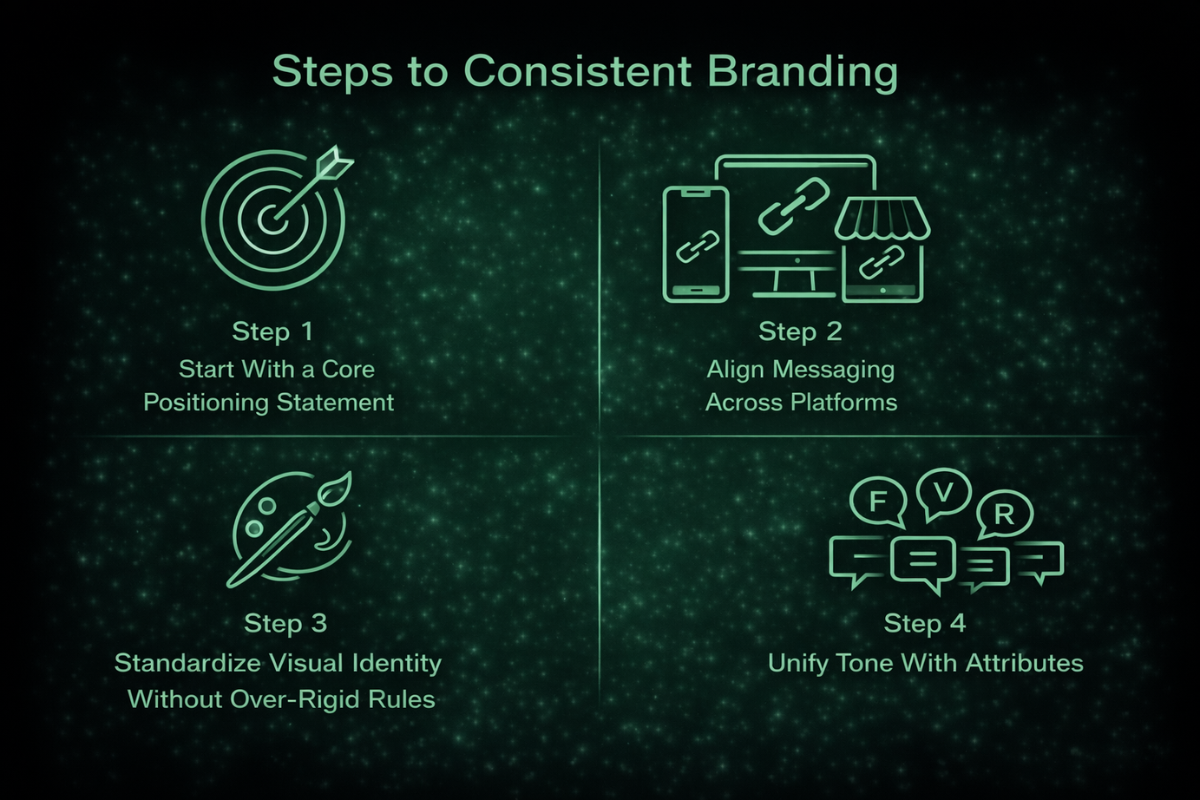
Step 1: Start With a Core Positioning Statement
Clarify:
- Primary audience
- Core problem solved
- Unique differentiator
- Emotional promise
Every channel should reinforce that foundation.
Step 2: Align Messaging Across Platforms
Review:
- SEO titles and meta descriptions
- Paid ad copy
- Homepage headlines
- Email campaigns
- Social bios
Look for contradictions. Simplify where needed.
Step 3: Standardize Visual Identity Without Over-Rigid Rules
Even though it may look like monotony at first, consistency actually means cohesion.
Define:
- Primary and secondary color palettes
- Core typography
- Image style direction
- Layout principles
Then ensure all assets follow the same visual logic.
Step 4: Unify Tone With Attributes
Instead of writing strict scripts, define tone attributes:
- Confident but not arrogant
- Clear but not technical
- Approachable but not casual
This keeps the voice flexible yet consistent.
Audit, Align, and Protect Your Conversion Engine
Start with an honest audit of your brand across every customer touchpoint.
Map your messaging from ads to landing pages to checkout. Review your visual identity across platforms. Listen to your tone of voice in different contexts. Where you find contradictions, you've found conversion leaks.
The brands that win aren't necessarily the ones with the biggest budgets or the flashiest campaigns. They're the ones that show up consistently, speak coherently, and build recognition that compounds into trust. Your brand should feel like one unified voice instead of a committee of strangers arguing in different rooms.
Fix your brand consistency, and you'll build a foundation for sustainable, long-term growth.

%20(1).jpg)