While you are bootstrapping your business, you try to keep costs to a minimum. This can lead you to make purchases that seem like good deals. Buying a business website for $300, or a subscription website builder for $15 a month, can seem like a responsible expense, but no one talks about whether there are hidden costs with cheap websites.
The costs are there, they are just not listed on the invoice. After six months, are you not seeing potential customers convert? Is your Google ranking low? Perhaps the developer is telling you that adding new features is more complex than expected. That is the real invoice that arrives after getting a cheap website.
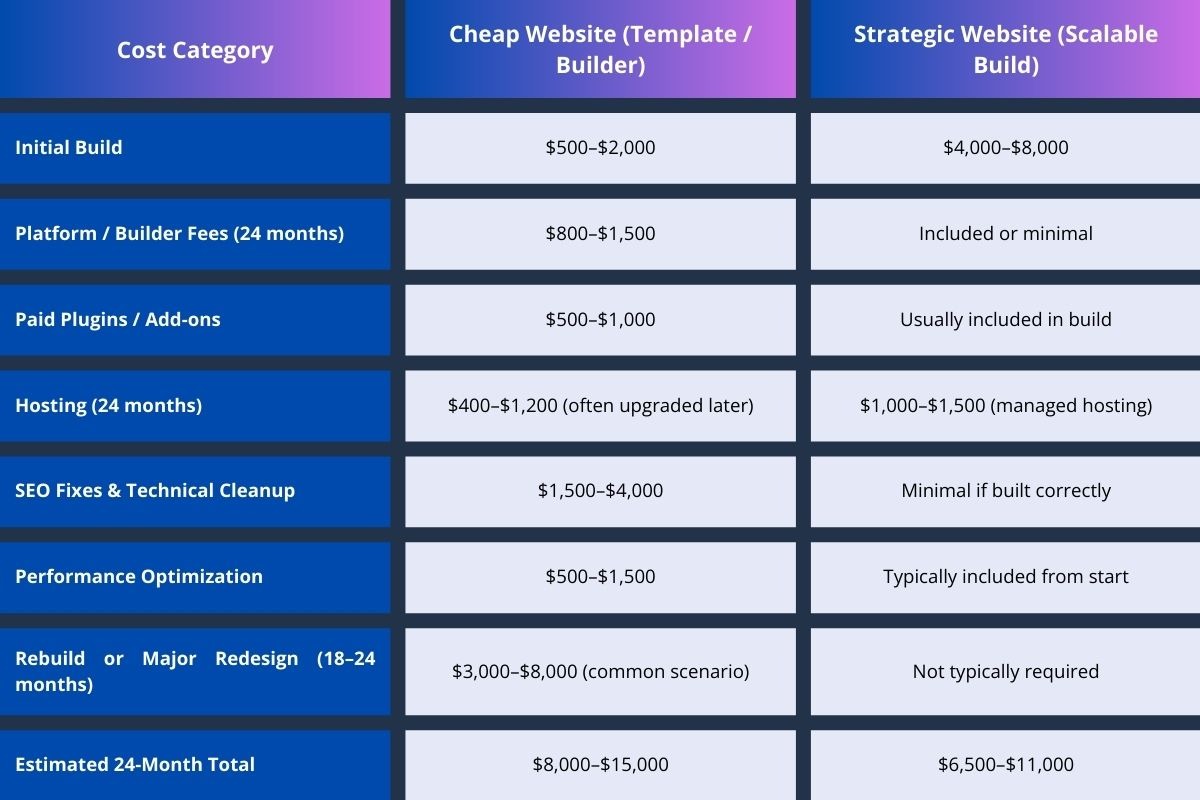
Are There Hidden Costs With Cheap Websites?
Not like most will think.
There is no line item called "future headache." What you see is a working site at launch, but over time, that site becomes a problem, with a plateau in traffic, a rise in bounce rate, and any change becoming increasingly burdensome.
Cheap websites are not built for durability. That decision, made by whoever built your site and not you, ultimately becomes the most influential factor when it comes to determining your growth ceiling.
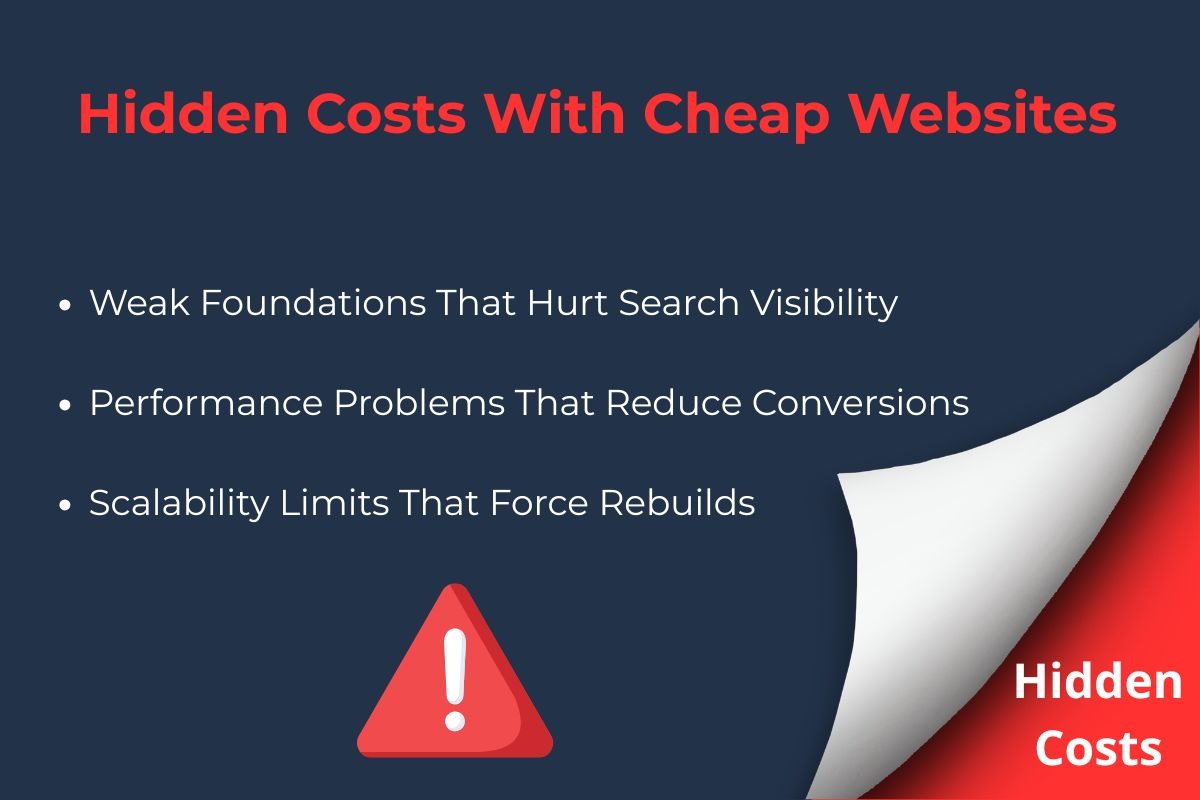
Weak Foundations That Hurt Search Visibility
Search engines reward not only useful content but also well-organized content.
This includes well-organized code, appropriate and logical heading order, quick load times, proper metadata, and useful internal links. Most inexpensive website builds do not include this type of work, typically opting for drag-and-drop builders or overcomplicated themes that are packed with unnecessary code for features that are never even used.
While the site may look good, the underlying structure is typically poor.
The majority of business owners first think that the site needs more blog posts or more specific keywords, and while this is sometimes the case, more often than not, the issue is site architecture, as no amount of content is going to resolve a poor internal linking structure.
Once website architecture becomes an issue, fixing it is rarely simple. Reworking the site requires a developer to redo the templates, clear out unnecessary code, or, in the worst case, start over entirely. This is not a content issue; it is a complete site construction issue.
Performance Problems That Reduce Conversions
Attracting visitors to your site is only part of the job. The second part of the job is to retain those visitors long enough to perform the actions that generate the desired outcomes.
Budget websites are usually built on unoptimized themes or hosted on cheap, overcrowded shared servers. This causes page speed issues on both mobile and desktop. The problem is made worse by the high bounce rate that slow-loading pages produce. Most visitors will leave within a few seconds if the page fails to load.
Most site speed issues do not present as obvious problems because visitors simply abandon the site, and revenue is lost quietly. This lost revenue is very difficult to quantify, and because of that, site speed issues are easy to overlook.
Scalability Limits That Force Rebuilds
A basic brochure site may work for you right now. However, businesses evolve. In the future, you will require enhanced analytics, better booking tools, e-commerce systems, CRM integrations, memberships, and other functionalities.
Most cheap websites are not built with future growth in mind.
Some growth-related challenges they nearly always have are:
- Inability to integrate with sophisticated CRM systems and other third-party tools
- Very little personalization beyond the initial template used to build the site
- Lack of access to control the backend and database
- Unnecessarily burdensome, expensive, and time-consuming site migrations
When your site no longer functions for your business, you cannot just add a room. In fact, you need to completely tear down the structure and build a new one.
With cheap websites, this is arguably the most common and most significant hidden cost.
Are there any hidden fees with these cheap website builders?
Yes, and this aspect really surprises many people.
The advertised price is often just a promotional starting point. As your business expands, your needs will often outgrow your current tier and require you to pay for an upgrade.
Costs that often catch people by surprise include
- Paying to remove the platform's branding from your site
- Paying to unlock adequate SEO control
- Paying to enable e-commerce
- Paying for additional storage or bandwidth
Costs that start at $20 a month can easily escalate to $80 or $120 once you are actually running a business on the platform.
Another cost that is often overlooked is ownership. Some platforms trap you at the level of their infrastructure. If you want to leave, your content will be stuck in their system, in their format. If you ever wish to move, you may find there is nothing viable to export. You are not migrating a site. You are rebuilding one.
When changes become necessary, that level of lock-in becomes expensive very quickly.
The Technical Debt Invisible to Most Businesses
The concept of technical debt is specific to developers, but it absolutely applies here.
When a site is built quickly and on the cheap, corners are cut. Plugins remain unupdated. Themes are cobbled together in ways that will cause problems later. Pages are created without any consistent structure.
Initially, none of this is obvious. But as time goes on, simple edits start to break things. Updates clash. What should take 20 minutes becomes a half-day ordeal.
You stop strategically improving the site because you are too busy holding it together reactively. That ongoing maintenance cost, both in terms of money and irreplaceable time, adds up.
The Lasting Effects on the Business
All of this circles back to something more important than just technical issues.
A badly designed site can slowly erode
- Organic traffic
- Lead generation
- First contact conversion
- Brand reputation
When people land on a poorly designed site, they make a judgment about the business. It does not matter how good the product is. If the site is slow, out of date, or hard to navigate, customers will not trust the business.
This is what makes the question "Are there hidden costs with cheap websites?" so serious. It is not just about fixing issues or paying a developer. It is about the momentum and potential that were never built in the first place.
A Realistic Example
A business launches a website as cheaply as possible to save money. For a period of time, the website functions well enough, and the layout is not awful.
They begin running ads. Their website gets visitors, but the visitors do not convert. The website is not ranking for any searches. They want to add CRM integration, but it ends up being far more complicated than expected. They hire a developer who tells them the site was not built to scale and recommends rebuilding it entirely.
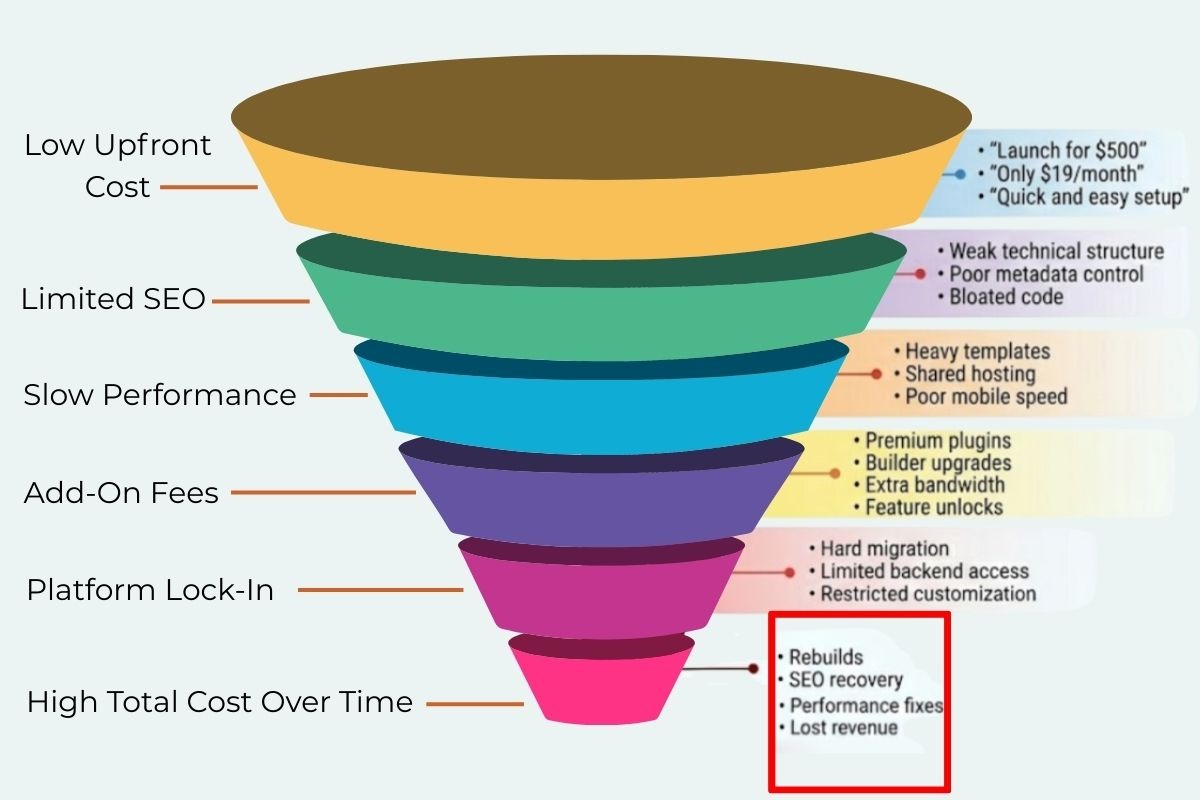
Now they have to pay again, and they have lost time. In a competitive environment, time is often the most valuable thing lost, worth far more than anything they saved by cutting costs in the first place.
What Most Cheap Website Builders Overlook
The first step before creating any page in a new website project is establishing a proper URL hierarchy.
Budget builders fail to do this. They create pages wherever seems appropriate at the time, often prioritizing appearance over structure. When a redesign eventually happens, URL structures get reorganized, and without proper redirects in place, a website can lose its search engine rankings and backlink equity overnight.
It is a simple step that does not take long to do correctly. It is an easily avoidable mistake that can result in an SEO recovery period spanning several months. Very few budget website builders ever bring this up. Those who do, like the team at Jungle Creatives, help their clients avoid some of the most expensive mistakes and headaches down the road.
Choosing Affordability Without Sacrificing Strategy
It is possible to prioritize affordability while maintaining a strategy.
Being budget-conscious and staying strategically sound are not mutually exclusive. Saving money in the immediate term does not have to come at the expense of building something that provides lasting value over the longer term.
Who you partner with and the vision they have beyond launch day is often what makes the greatest difference. A site that is well built with clean code and a plan for future growth will typically cost less over time than a cheap site that needs a complete rebuild within the first 18 months.
The goal is not to spend more. It is to spend once, and to spend right. Build the site to a place where it is able to evolve as the business evolves.
Make the Smart Decision Before It Costs You More
Before you jump at the lowest price, take the time to ask the right questions. What are the hosting arrangements? Who owns the data? Is the site cleanly exportable? What will it cost when you need to add functionality in a year?
Consider where your business will be two years from now, not just how the site looks next Tuesday.
The concern is not simply whether there are hidden costs with cheap websites. The real concern is whether the site you are building today will be sufficient for the business you are growing into tomorrow.

%20(1).jpg)