At some point in almost every e-commerce project, the same question comes up: Is Shopify flexible enough for what we want to build?
The concern usually hides behind phrases like “fully custom,” “advanced functionality,” or “long-term scalability.” And often, it’s framed very bluntly: Is there a limit on Shopify, or will we eventually hit a wall?
The short answer is that Shopify does have boundaries. However, they’re rarely the ones people think of. The longer, more useful answer is that Shopify’s real power lies not in how much you can bend the platform, but in how intelligently you design around it.
Let’s unpack what “fully custom” really means in the Shopify ecosystem, where flexibility truly lives, and why Shopify scalability depends far more on planning and architecture than on the platform itself.
What “Fully Custom” Actually Means on Shopify
In Shopify conversations, fully custom is often misunderstood as “no constraints at all.” That expectation alone leads to disappointment.
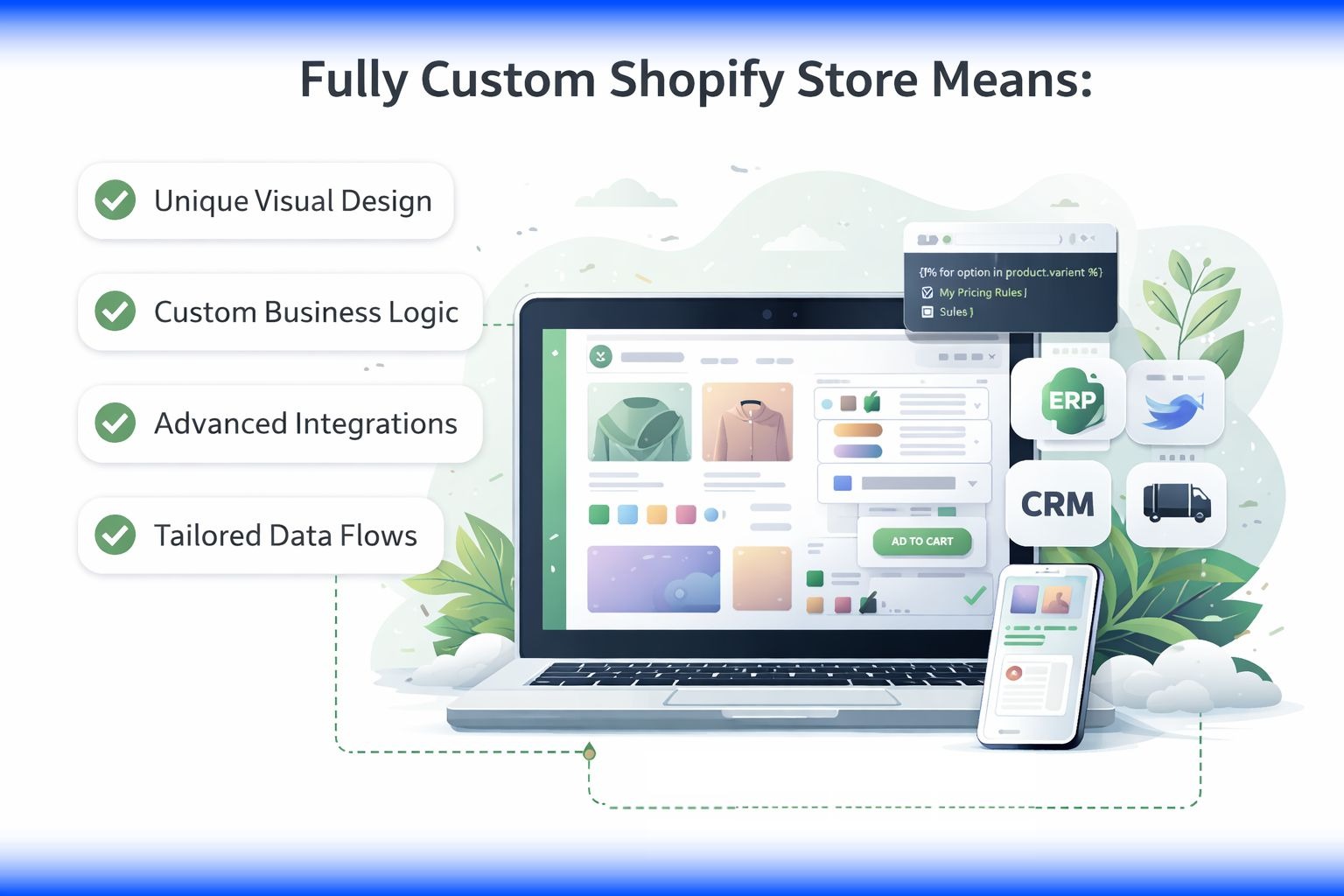
In reality, a fully custom Shopify store means:
- A completely bespoke user experience and visual design
- Custom storefront logic tailored to your business model
- Advanced integrations with external systems
- Extensibility through APIs, custom apps, or headless components
What it doesn’t mean is rebuilding core commerce infrastructure from scratch. Shopify deliberately owns areas like hosting, payments, checkout security, and performance optimization. Instead of limiting creativity, this frees teams to focus on what actually differentiates a brand.
When approached correctly, Shopify gives you enormous freedom where it matters most: customer experience, conversion strategy, and operational efficiency.
Visual Customization: Almost Unlimited by Design
From a visual and UX standpoint, Shopify is remarkably open.
Custom themes built from the ground up allow brands to:
- Design layouts without relying on pre-made templates
- Implement unique interactions, animations, and storytelling
- Optimize every screen for conversion and usability
- Match brand identity without compromise
You’re not restricted to the theme editor or “drag-and-drop” aesthetics. With custom development, Shopify becomes a rendering engine for your design vision rather than a design system you must obey.
This is where many brands unlock custom options. Shopify stores are known for personalized product layouts, dynamic content sections, and UX patterns that feel anything but generic.
Functional Flexibility: Where Strategy Matters Most
While visual customization is largely unrestricted, functional flexibility depends on how well the store is architected.
Shopify supports:
- Custom pricing logic
- Product bundles and subscriptions
- B2B and wholesale workflows
- Complex fulfillment rules
- Multi-market and multi-currency setups
These features often rely on advanced custom options Shopify provides through APIs, metafields, custom apps, and third-party integrations. The key is knowing when to extend Shopify and when to let it do its job.
This is where the myth of “Shopify can’t do that” usually falls apart. In most cases, Shopify can support the functionality, but not always in the most obvious or naive way.
Common Misconceptions About Shopify’s Limits
“Shopify is only good for small stores.”
Some of the world’s largest ecommerce brands run on Shopify. Size isn’t the issue—structure is.
“Apps will slow everything down.”
Too many apps can cause problems, but the issue isn’t the apps themselves. It’s a poor app strategy. Custom-built apps or carefully selected tools often outperform bloated all-in-one solutions.
“You can’t customize checkout.”
Checkout is protected for security and performance reasons. On Shopify Plus, extensibility expands significantly. But even on standard plans, most conversion optimization happens before checkout anyway.
“You’ll outgrow Shopify eventually.”
Most businesses don’t outgrow Shopify; they outgrow decisions made during rushed MVP builds.
Where Shopify Does Have Real Constraints
To be fair, Shopify isn’t limitless, and pretending otherwise helps no one.
Some constraints are intentional:
- Limited direct database access
- Controlled checkout logic
- Opinionated infrastructure decisions
These trade-offs exist to guarantee reliability, security, and performance under heavy load. For the vast majority of brands, these “limits” are actually safeguards that prevent costly mistakes.
The question isn’t “Why won’t Shopify let us do this?” It’s “Is this customization truly necessary, or just familiar?”
Shopify Scalability Is an Architecture Problem
This is the part many teams overlook.
When people ask about Shopify scalability, they’re often really asking whether Shopify can handle growth in:
- Traffic
- Product complexity
- Operational workflows
- Market expansion
Technically, Shopify can handle all of that. Where things break down is in:
- Poor product data modeling
- Overreliance on patchwork apps
- Hard-coded assumptions that don’t age well
- No separation between frontend, logic, and integrations
A well-architected Shopify store can scale calmly. A poorly planned one will struggle, even on a “more flexible” platform.
This is where Shopify's growth potential becomes less about platform choice and more about engineering discipline.
Headless, Hybrid, and Future-Proof Thinking
For brands with advanced needs, Shopify doesn’t force an all-or-nothing approach.
You can:
- Use Shopify as a backend commerce engine
- Build a custom frontend with modern frameworks
- Gradually move toward headless architecture
- Maintain performance while expanding flexibility
Importantly, you don’t need to go headless on day one. The smartest Shopify builds are headless-ready, not headless-by-default.
So… Is There a Limit on Shopify?
Yes, but it’s not where most people think.
Shopify limits low-level control to protect stability, security, and speed. What it doesn’t limit is creativity, growth, or complexity, if you plan properly.
A Shopify site can absolutely “fly” when:
- “Fully custom” is defined realistically
- Design and functionality are intentionally separated
- Scalability is considered from day one
- Shopify is treated as a platform, not a template
The real ceiling isn’t Shopify. It has unclear goals, rushed decisions, and short-term thinking.
Build smart, and Shopify won’t hold you back. It’ll quietly do what it does best while your business scales far beyond expectations.

%20(1).jpg)